Cross-section observation system
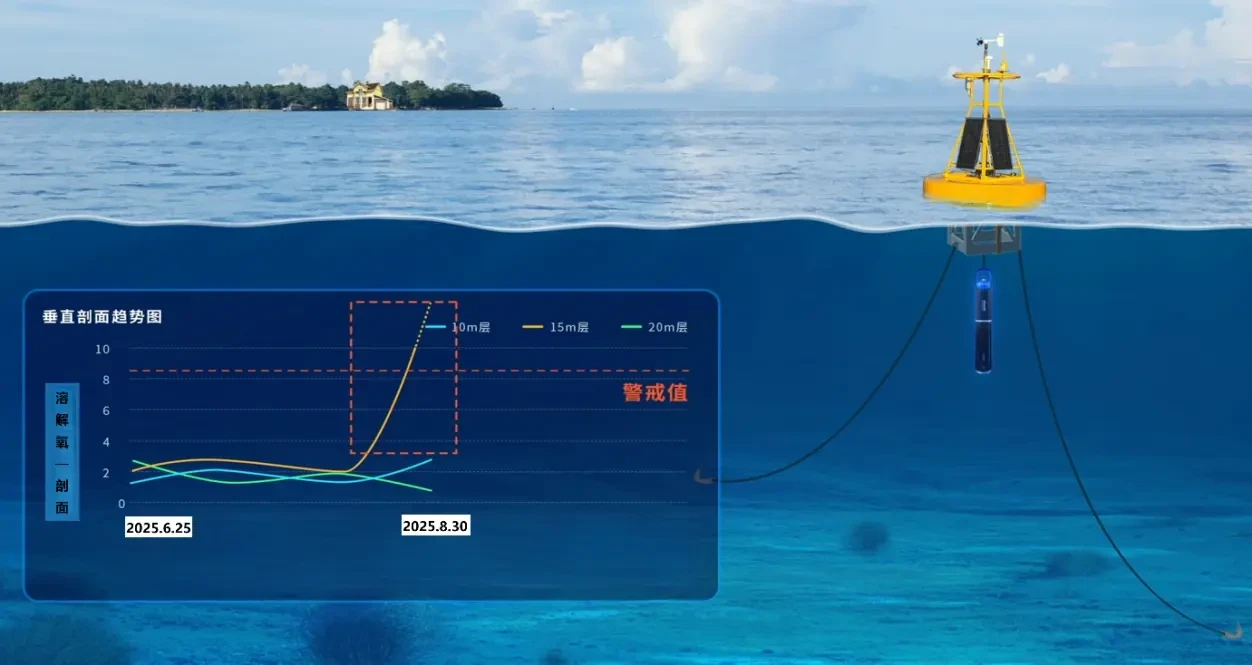
Buoy-based automatic profiling monitoring covering 5~100 m water depth to collect vertical profiles of water quality parameters.
Product Overview
The profiling observation system uses a buoy as its platform, integrating the buoy body, anchor mooring, safety protection, solar power supply, automated vertical profiling, data acquisition and transmission, and shore station reception. During operation, a winch drives water quality sensors from the surface to deeper layers, collecting water quality parameters at various depths. After measurement, the sensors are retracted into the instrument compartment, generating long-term, continuous vertical profile data suitable for water quality monitoring in coastal areas, estuaries, lakes, and reservoirs.
- The buoy platform integrates the buoy body, mooring system, power supply, and safety protection systems.
- Automated vertical profiling with layer-by-layer water quality data acquisition
- Beidou positioning and geofencing alerts: Remote alert push platform and app
- Dual-link transmission via BeiDou and 4G; automatic resending of missing reports
Product Performance Specifications
General Requirements
Operates normally for ≥ 1 years under the following environmental conditions.
- Working depth: covers 5 to 100m
- Wind Speed: Covers 0~60 m/s
- Wave Height: Covers 0~15m
- Tidal range: covers 0~6m
- Surface flow rate: Covers 0~3m/s
- Ambient temperature: -10°C to +50°C
- Shock: Peak acceleration covers 0~300 m/s²
- Tilt: ≥30°
Buoy body
- The main body is constructed from high-quality non-metallic materials and coated with anti-corrosion, anti-aging, and anti-fouling marine coatings.
- Diameter ≥ 3m, Total Weight ≤ 2t
- Equipped with a mounting tower for device installation. The tower shall be constructed from non-magnetic, highly corrosion-resistant metal material (304 stainless steel or better).
- The hatch cover is equipped with anti-theft measures, and the buoy body has ≥1 lifting lugs or mooring cleats.
- Buoy lifespan: ≥5 years
Anchor System
- Octopus mooring system suitable for cross-section monitoring, designed for water depths ranging from 5 to 100 m.
- Anchoring materials are corrosion-treated and coated with anti-corrosion paint.
- The anchoring unit's corrosion resistance, structural strength, and anchor block load-bearing capacity ensure the buoy operates normally in severe marine conditions with typhoons of ≥12 Beaufort scale.
Security Protection System
- Equipped with positioning systems like BeiDou for real-time buoy tracking, with geofencing alerts based on location data. Features concealed installation and independent power supply to prevent buoy drift caused by power system failures, ensuring continuous location access even when outside the preset range.
- Alarm System: Features leak detection, low battery, displacement, malfunction, and temperature anomaly alerts. Automatically sends alert notifications to designated platforms and the mobile app.
- Solar navigation light with visibility ≥ 5.5 km, emitting yellow light as required for the waterway.
- Equipped with lightning protection
- The radar reflector provides an effective reflective area of ≥10 m² within the 9320~9500 MHz frequency range.
- Underwater instrument protective tubes and gain antennas made of copper-nickel alloy
Power Supply System
- Powered by a combination of solar panels and batteries with single DC output, equipped with charge/discharge controllers and power control modules to independently supply different measurement instruments.
- Supply voltage: 12V ± 2V; Solar panel power: ≥ 320W; Battery capacity: ≥ 400Ah (12V)
- The solar-powered buoy system can operate for at least 20 days without charging. The solar panel is easy to install and remove.
Automated Lift-and-Lower Profiling Monitoring System
- The system drives the multi-parameter water quality instrument (procured in this project) to move vertically from the surface to deeper layers during measurement. Water quality sensors record parameters at various depths as the instrument moves.
- The system features a professional profile management program that supports setting a maximum measurement depth of ≥100m.
- Set monitoring intervals as needed. Supports configuring lift frequency and vertical lifting distance.
- Configurable monitoring point accuracy: ≤0.1m
- Minimum profile clearance: ≤0.5m
- Profile crawling speed: 0~20 cm/s
- Automatically determine monitoring point locations based on water level changes
- Automated cable spooling ensures tight, orderly winding during deployment and retrieval, preventing tangles, knots, and slippage. The control system provides precise operation and real-time alerts to avoid entanglement between the hoisting cable and instrument cables, while ensuring the anchor unit and automatic instrument升降 system operate independently without interference.
- After completing measurements, the winch retrieves the multi-parameter water quality sensor. After each profile measurement, the suspended instrument remains on the water surface for an extended period.
- The system's control unit includes a protective enclosure, keeping the cross-section system within the instrument bay under harsh hydrological conditions.
Data Acquisition and Transmission System
- The data acquisition module supports data collection, processing, storage, quality control, status monitoring, transmission, power control, fault diagnosis, and remote control. It enables remote adjustment of the working frequency of measurement sensors.
- Data collection intervals can be configured to include, but are not limited to, 15-minute, 30-minute, 1-hour, 2-hour, and 4-hour modes. Custom configurations are also available based on the purchaser's requirements.
- Monitoring data is compressed into files, automatically transmitted to the shore station system on a scheduled basis, and simultaneously stored in the collector with a capacity of at least 1 years.
- The data collection module features built-in data storage.
- The data file includes observation time, station information, observation data, device status data, and buoy status data.
- Data transmission uses Beidou and 4G networks, supporting wireless data and control command transfer.
- The buoy features automatic data retransmission, which can automatically resend missing reports for up to ≥6 data points.
- Data Reception Rate: ≥90%
Shore Station Receiving System
- Features include data reception, processing, graphical display, storage, and analysis.
- Under normal conditions, the reception time of the last data shall not exceed 30 minutes past the hour.
- Real-time Acquisition and Display: The shore station data receiver establishes bidirectional communication with monitoring sensors and supporting equipment. It receives real-time field monitoring data based on configured acquisition and refresh cycles, displays instrument performance and status—including power supply status and sensor diagnostic metrics—and enables remote control of buoy-mounted devices/components as well as parameter configuration.
- Alarm Detection and Handling: Real-time monitoring for buoy position out of range, low battery voltage, and abnormal readings across all monitored parameters. Triggers appropriate responses, logs relevant parameters at the time of alarm, stores them in the alarm database, and sends parameter alert notifications.
- System Log: Records all operations and events that occur during runtime.
- Query Function: Displays real-time data, hourly data for any time period, and configured system or instrument parameters in curve or table formats.
- Parameter Settings: Configure measurement intervals or durations for each sensor, and define alarm limits and exception thresholds for all parameters.
- Remote Access: Select a preferred communication network to query real-time data, historical data, alarm logs, system logs, and all buoy system information at any time. Remotely control buoy devices and components, and configure parameters—enabling full remote operation of the buoy system.
- Data Analysis: Comparative analysis of different monitoring parameters for the same buoy
- Reporting: Generates reports in standard formats; all reports can be saved and printed as Excel files.
Need detailed product information?
Contact our technical team for the complete solution and configuration recommendations.